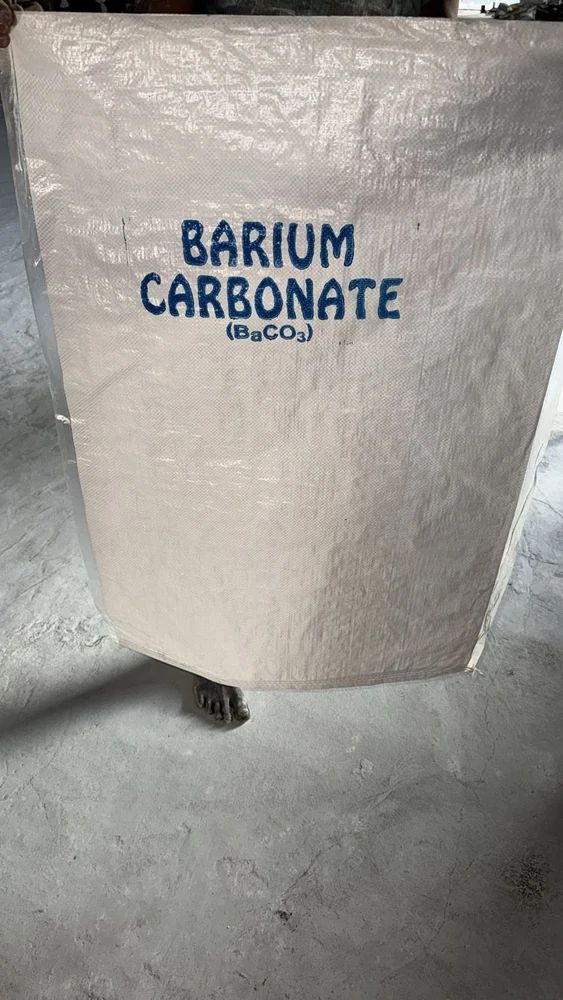
About Barium Carbonate Powder
| Packaging Size |
25 Kg |
| Form |
Powder |
| Packaging Type |
Bag |
| Cas Number |
513-77-9 |
| Molecular Formula |
BaCO3 |
| Molar Mass |
197.34 g/mol |
| Solubility product |
2.58.10-9 (Ksp) |
| Solubility |
Decomposes in Acid; Insoluble in Methanol |
| Heat Capacity |
85.35 J/mol.K (C) |
| ChemSpider |
10121 |
| PubChem CID |
10563 |
| Melting Point |
811 deg C (1,492 deg F; 1,084 K) |
| Boiling Point |
1,450 deg C (2,640 deg F; 1,720 K) |
We have been counted amongst the most trusted names in this domain, engaged in offering a standard quality range of these products.
Exceptional Purity and CustomizationWith a typical purity of 99% and customizable particle sizes, Barium Carbonate Powder meets the stringent requirements of industrial and laboratory applications. Each batch is carefully processed to ensure low moisture and minimal impurities, enhancing performance across varied uses from ceramics to chemical synthesis.
Optimized for Industrial ApplicationsBarium Carbonate Powder is designed for use in glass and ceramics, ferrites, brick enameling, and laboratory research. Its stable, finely powdered form makes it easy to handle and incorporate into existing manufacturing processes, supporting consistent quality results every time.
Safe Packaging and Reliable StoragePackaged in HDPE bags with secure inner liners, Barium Carbonate Powder is protected from moisture and contamination. To maintain its quality, store in a tightly sealed container, in a cool, dry place. When stored under proper conditions, it remains stable and effective for up to 24 months.
FAQ's of Barium Carbonate Powder:
Q: How should Barium Carbonate Powder be safely handled and stored?
A: Always handle Barium Carbonate Powder with care, avoiding ingestion and inhalation as it is classified as a toxic substance. Store the powder in a cool, dry location in a tightly sealed container to prevent moisture intrusion and contamination. Properly stored, it remains stable for up to 24 months from the date of manufacture.
Q: What are the common applications of Barium Carbonate Powder?
A: This powder is frequently used in ceramics and glass manufacturing, the production of ferrites, brick and tile enameling, chemical synthesis, and as a rodenticide. Its high purity and chemical stability make it suitable for both industrial and laboratory use.
Q: When should Barium Carbonate Powder be incorporated into the production process?
A: Add Barium Carbonate Powder during the raw material preparation stage to ensure even distribution and optimal reaction with other components in ceramics or glass production. Following recommended safety procedures is essential during handling and mixing.
Q: Where does Barium Carbonate Powder provide the most benefit?
A: Its benefits are most pronounced in industries requiring high-purity, stable chemical additives, such as ceramics, glass, and ferrite manufacturing. It helps improve efficiency, color, and durability in finished products while minimizing impurities.
Q: What precautions should be observed when using Barium Carbonate Powder?
A: Wear suitable personal protective equipment, such as masks and gloves, to avoid direct contact and inhalation. Ensure adequate ventilation in the workspace. Avoid contact with acids and oxidizers, as the powder is incompatible with these substances.
Q: How does Barium Carbonate Powder enhance product quality in manufacturing?
A: Its fine, free-flowing particle size and low levels of impurities contribute to improved material integration, color consistency, and stability in ceramic glazes, glass products, and ferrite magnets, resulting in superior end-product quality.






 Send Inquiry